Rates First, AI Second: Fed Repricing, AI Funding Stress and the US Yield Curve
Personal views only. Not investment advice, and not the views of my employer.
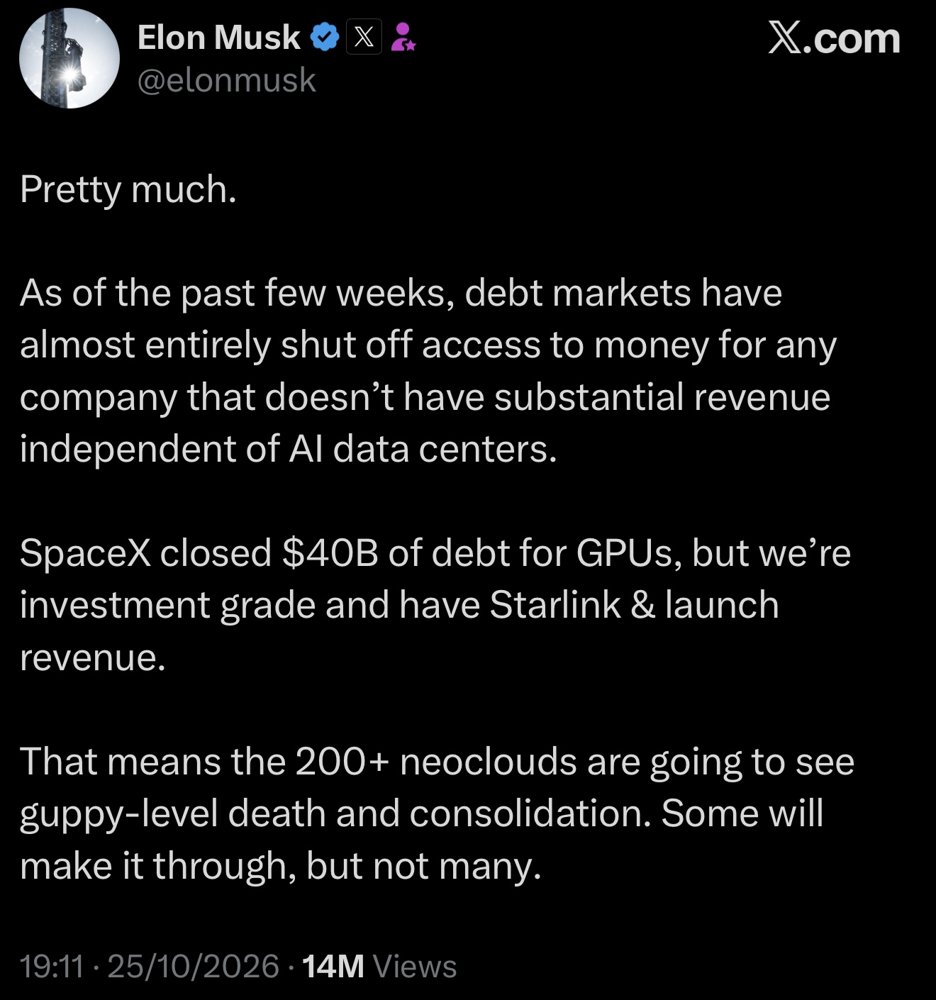
I want to begin this note by highlighting a post from Elon Musk on October 25th. SpaceX had just completed a raise of $40bn of debt for GPUs, and a point was raised that lenders are pulling back from anyone without substantial non-AI revenue. SpaceX is investment grade with Starlink and launch revenue behind it; a neocloud isn't. This anchored my chain of thought and sent me down this road.
Thesis
Is the funding leg for the AI trade beginning to come under stress? And is this isolated to that sector, or is it the first sign of rates repricing higher across the board, dragging broader risk assets down with it?
The core idea revolves around inflation, sticky core inflation to be precise. With energy prices still well above last year's levels and feeding through to services, the Fed may be pushed to hike rates well into 2027, beyond the levels currently priced (~2 hikes at the time of writing).
2s would rise faster than 10s, and the pain would be felt in long-duration equities and weaker AI borrowers first, with, in my view, nothing backstopping them.
Why now
The following has lined up over the last few weeks.
- The political climate shifted. Congress changed hands at the midterms and the market's pricing tougher AI and data centre regulation. My read is that markets anticipated this well before the midterms and that credit markets began tightening weeks before November 3rd, so the political regime may well have kicked it off but this isn't the full story.
- Funding's pulling back at the AI frontier. Lenders want more from borrowers without big non-AI revenue. CoreWeave's 2031 notes hit a 17.91% yield on Nov 25th (Tradeweb), and HSBC sold $300m of Stargate-linked loans at mid-80s of face (Bloomberg).
- Inflation isn't going away. Core PCE is 3.3% (BEA, Oct), growth and jobs are strong, the Fed's signalling hikes, and energy is still well above last year's levels as the stalemate in Iran drags on.
Current market facts
Levels as of Nov 25th–26th, 2026 unless stated.
| Item | Level | Date | Source |
|---|---|---|---|
| S&P 500 close | 6,910.39 on Nov 20th (down 8.61% w/w from 7,561.67); 7,182.78 on Nov 25th | Nov 13th, 20th and 25th, 2026 | TradingView |
| ICE BofA US HY OAS | 3.72% latest, vs 3.52% on Nov 19th | Nov 24th, 2026 (latest FRED print) | FRED |
| CoreWeave bond yield | 2031 notes (9.75%) 17.91%, price 74.23; 2032 notes above 16% on Nov 6th | Nov 25th, 2026 | Tradeweb; CNBC |
| Fed hikes priced | 2 hikes - one in Dec, one in Q1 '27 | Nov 2026 | CME FedWatch, Nov 25th (Dec: 97.8% for 25bp; 2nd hike by Jan: 58%); fed funds target 3.75-4.00% |
| 2y and 10y Treasury, 2s10s | 2y 4.65%, 10y 4.86%, 2s10s +21bp | Nov 25th, 2026 | TradingView (US02Y, US10Y) |
| IG OAS | 0.98% | Nov 24th, 2026 (latest FRED print) | FRED via TradingView |
| Inflation (latest) | Core PCE 3.3% y/y (vs 3.2% expected), headline PCE 3.8%. Core CPI +0.3% m/m for a third month; last y/y was 2.6% (Sept) | October data (PCE out Nov 25th, CPI out Nov 10th) | BEA, Personal Income and Outlays (Oct 2026); BLS CPI |
Equities
The S&P dropped 8.61% in the week to Nov 20th and is still down about 6% over one month, despite a bounce to 7,182.78 on Nov 25th. AI names, which have carried index returns for two years, are leading the downside price action.
Below is a snippet of the selling on Nov 20th. Notice how the selling was concentrated in the names strongly tethered to the AI buildout.
| Group | Name | Nov 20th |
|---|---|---|
| AI chips | NVDA | −14.0% |
| AI chips | AMD | −13.3% |
| AI memory | MU | −13.9% |
| Neocloud | NBIS | −16.1% |
| AI-linked borrower | ORCL | −8.5% |
| Megacap | AMZN | −3.2% |
| Megacap | GOOGL | −2.7% |
| Megacap | AAPL | −1.9% |
| Index | QQQ | −5.5% |
Source: TradingView, daily change on Nov 20th, 2026.
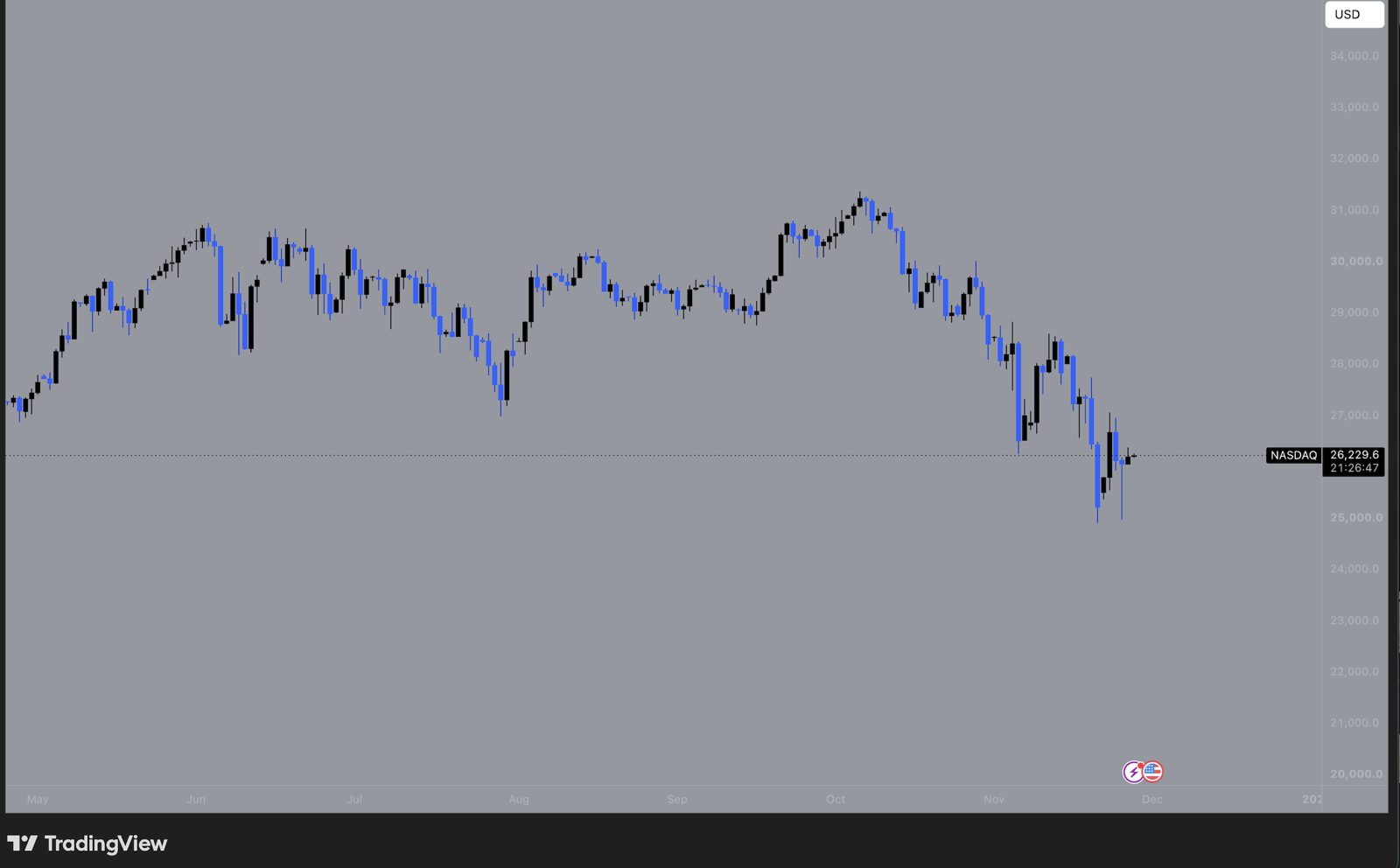
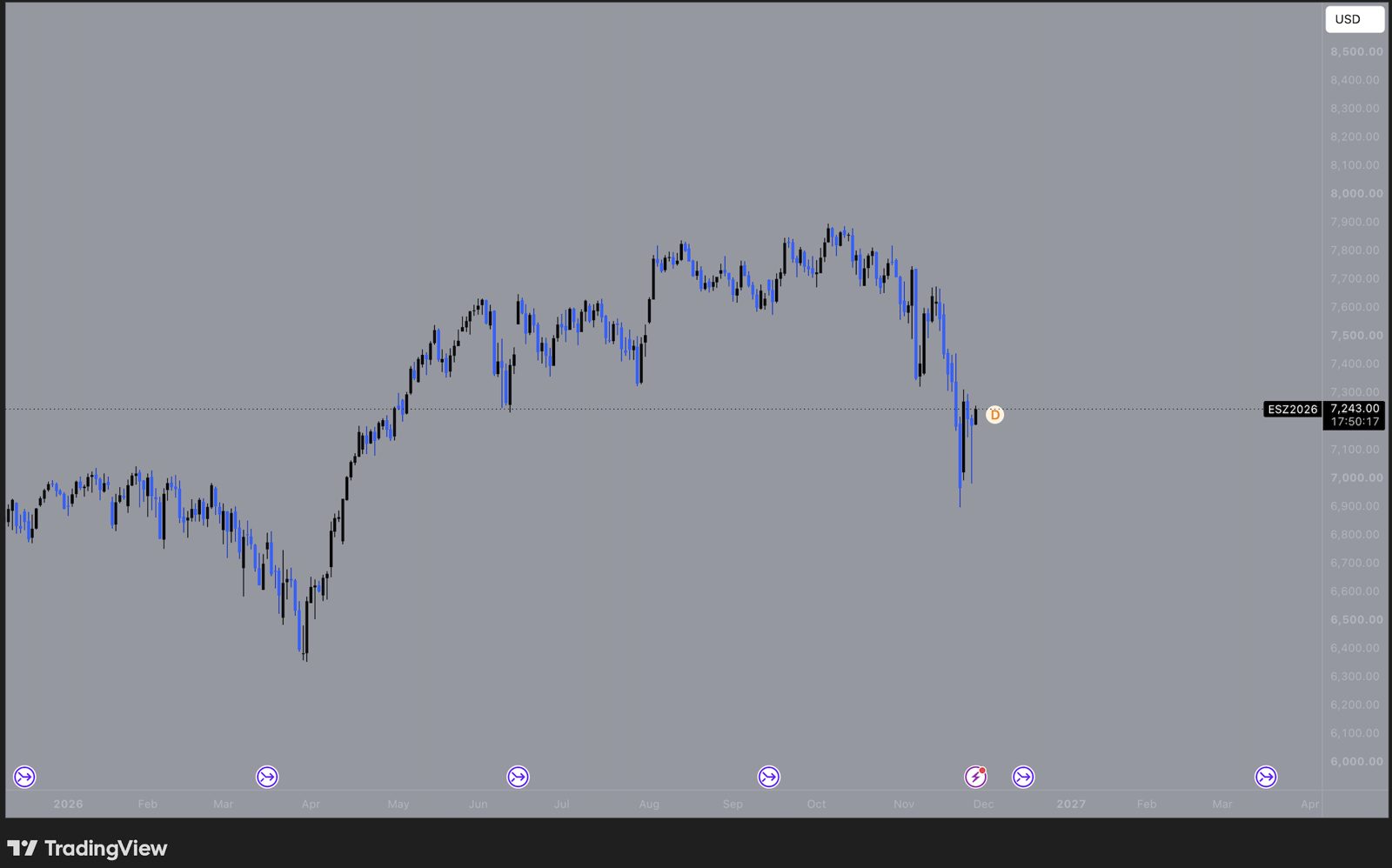
My current view is that equities look like they're pricing a growth scare in AI, the sector that has driven a large share of index returns over the last two years, now with cracks starting to appear.
Unfortunate news for bulls is that IF hikes keep getting priced in, long-duration names have further to fall. I believe this is the most likely path at this moment in time.
I am currently neutral to bearish on equities, both at an index level and increasingly at a sector level, specifically AI and the frontiers linked to the massive capex buildout.
Credit: what is priced
HY OAS widened over 50bp in about a week to 3.76% on Nov 20th and now sits at 3.72% (FRED). CoreWeave's 2031 notes hit 17.91% on Nov 25th (Tradeweb). Lenders are tightening on AI borrowers without big non-AI revenue. SpaceX's $40bn debt raise for GPUs is the contrast: investment grade, per Musk, with lots of non-AI revenue.
My read on this is that the market's sorting AI borrowers by balance sheet, not pricing a full default cycle. 3.72% is still tight, so the speed of widening matters more than the level.
Latest (Nov 24th–25th): Stress is spreading. CoreWeave's 5y CDS rose 8.5% to over 1,200bp, and the cost of insuring Oracle and Nvidia debt also rose (CNBC); Oracle 5y CDS was around 295–300bp earlier in the month (CNBC). Banks are offloading AI data centre loans: ING offered $500m, HSBC sold $300m of Stargate-linked loans at mid-80s of face, and Societe Generale sought buyers for $300m of Oracle-related debt (Bloomberg, FT). The ECB puts euro area banks' AI-related lending at about €75bn, just 1.1% of their corporate exposures (ECB Financial Stability Review, Nov 18th), so systemic risk looks limited for now.
Rates and the curve
Markets are currently pricing about two more hikes. CME FedWatch puts a 25bp December hike at 97.8% and a second by January at 58% (Nov 25th): roughly two hikes across December and early 2027. Core PCE is running at 3.3% (BEA, October), well above the Fed's 2% target, and the Fed is signalling more hikes.
My view is that two is too few, and absent a systemic shock there isn't anything to stop the Fed in its tracks.
On AI
The market's treating AI funding stress as a sector problem whereas I see it as the early edge of a rates problem. Credit's already pulling back at the AI frontier, while the Iran war and sticky energy keep inflation up through services. The Fed may have to hike more in 2027 than what is priced, which hurts long-duration AI and tech equities first, then cascades from there. With the Fed tied to its inflation mandate and a Democratic Congress openly less accommodative to AI, there's elevated uncertainty and reduced open support domestically to keep the train running.
Transmission mechanisms
- Inflation's above target, growth and jobs are strong, and the Fed's signalling hikes.
- Energy and supply shocks feed into core via services. Gov. Waller says inflation is 'spreading out' (CNBC, Nov 18th), and Fed staff research suggests energy now passes through to core more persistently than pre-pandemic. The Fed can't fix supply shocks, but it can certainly keep hiking.
- The front end reprices higher, 2s rise faster than 10s, and the risk-free floor lifts for every borrower.
- Long-duration equity valuations fall, and AI borrowers with thin non-AI revenue lose access first.
- AI capex slows, growth softens, inflation stays high. Stagflation on the cards?
Ranking: rates first, AI stress second, politics as the kick-off. That said, it could run the other way: AI stress driving rates rather than rates driving AI stress. And Iran and energy could be behind both. One to watch, not a settled call.
Key indicators
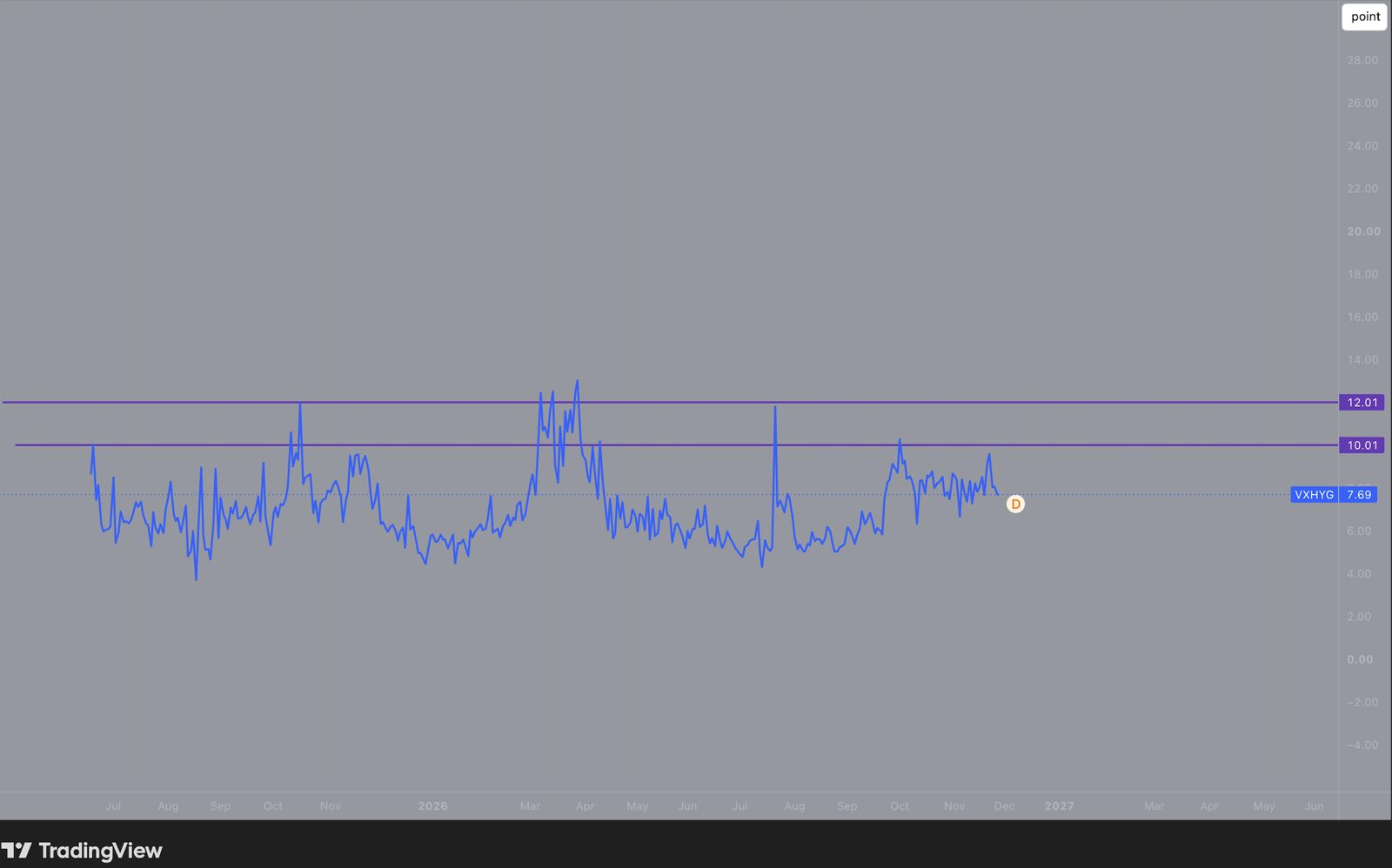
- HY vol first, spreads second. My main trigger is VXHYG, basically the options market's read on junk bond volatility, with MOVE alongside it. A close above 10, or a 30%+ jump in a week, is my warning sign. Above 12, around the March peak, is confirmation, but only if HY OAS is widening at the same time. Right now VXHYG sits at 7.69, MOVE at 97.55 (Nov 25th) and HY OAS at 3.72% (TradingView, FRED), so nothing's triggered yet.
- Fed hikes priced for 2027 (SOFR futures, CME FedWatch).
- 2y yield and 2s10s. A bear flattener is the base case.
- IG versus HY and AI-name spreads. Tightening across AI-linked and IG names would say it is not an AI-concentrated problem.
- CoreWeave and neocloud bond yields.
- Core PCE, core CPI, services inflation, oil.
Catalysts through year-end
- December FOMC on Dec 9th (hike priced, about 98%) and the dot plot.
- November CPI on Dec 10th, the day after the FOMC, and PCE.
- Any Iran deal or breakdown, the biggest swing factor.
- AI capex funding events, including new bond issuance, loans and CoreWeave.
Trade expressions
Ideas into year-end and the 2027 hike path. NFA.
- Rates: short 2027 SOFR futures. December is already priced, so the edge is in 2027: I expect more hikes than the market prices, unless a clearing event forces the Fed to step in and reverse course. Short 2y is the simpler cash alternative.
- FX: long USD (DXY). Money leaving long-duration assets needs a home, and higher rates make dollars more attractive. The risk is that deficits and sovereign-stress concerns could weaken it.
- Equities: underweight, not outright short. Bearish with a view to buy, so close to neutral on the index; avoid neoclouds and Nvidia (yes, even with Jensen back).
- Credit: not a trade but rather a signal, with HY spreads widening being the stress indicator.
Time horizon: end of 2026, with the main repricing expected in the rest of Q4 2026 and into the 2027 hike path.
Risks and opposing arguments
Strongest opposing case: inflation fading, hikes get priced out and 2s fall faster than 10s (a bull steepener). AI slows but doesn't stop: SpaceX's $40bn debt raise, Anthropic's IPO and big cash pile show well-funded players have the means to keep financing their capex.
Other risks:
- The Iran stalemate resolves. I think a deal is unlikely given a month of stalemate, but that is my judgment, not evidence.
- If things get bad enough that the Fed has to step in and cut, my equity view still works but my rates trade gets hurt.
- The dollar leg could fail if markets start worrying about US government finances. Big deficits and heavy Treasury issuance can make investors demand more to hold US assets. If foreign buyers step back, Treasuries and the dollar can fall together, even while the Fed is hiking. A Fed pivot would also weaken the dollar.
Oil: energy is still elevated on the year, but it is falling. Front-month Brent futures are $91.08 and WTI $84.28 (Nov 26th), down 17.6% and 16.9% over one month but still up 47% and 45% over one year (TradingView, ICE BRN1! and NYMEX CL1!). October inflation data predates the drop, so headline prints may soften. But oil is still well above last year's levels, consumers still feel it, and the bigger issue is core: core PCE is 3.3% and core CPI has risen 0.3% a month for three months. Core is what keeps the Fed hiking.
You may notice that the trade legs expressed are all correlated: short 2027 SOFR, long USD and the equity underweight all pay off in a hawkish-repricing scenario, so they are one bet, not three. Credit is a signal here, not a position. If a growth scare forces the Fed to step in and cut, my equity view still works but my rates trade gets hurt.
Invalidation conditions
- An Iran deal that pulls energy and inflation lower: the biggest single factor.
- Inflation prints falling enough to price out hikes.
- A Fed pivot. I expect one only if something breaks, but markets can get ahead of it.
- HY spreads tightening back across AI-linked and IG names, which would say stress is not spreading.
Conclusion
All in all, the AI funding pullback is real; however, the bigger lever is the front end. If 2027 hikes beat the ~2 priced, borrowers and long-duration equities both reprice to the downside. I'm watching HY spread velocity and the hike path. The regime materially changes if an Iran deal (again, unlikely at this time) or falling core inflation comes to fruition, taking hikes off the rate futures curve. I will be closely following this over the weeks to come.
Sources
- BEA, Personal Income and Outlays, October 2026 (PCE, core PCE)
- BLS, Consumer Price Index, October 2026 (core CPI)
- FRED / ICE BofA, US High Yield and Corporate OAS
- TradingView, S&P 500, US02Y, US10Y, VXHYG, MOVE, ICE Brent (BRN1!), NYMEX WTI (CL1!)
- CME FedWatch, December and early-2027 meeting odds, Nov 25th, 2026
- Tradeweb, CoreWeave bond prices, Nov 25th, 2026
- CNBC, AI credit and CDS coverage, Nov 6th and 24th–25th, 2026
- Bloomberg, ING and HSBC data centre loan sales, Nov 6th and 16th, 2026
- Financial Times, ING and Société Générale data centre loan sales, Nov 17th, 2026
- ECB, Financial Stability Review, Nov 18th, 2026 (AI-related bank lending)
- Federal Reserve, Gov. Waller, speech in London, Nov 10th, 2026, and CNBC interview, Nov 18th, 2026